
Articles That Inform
Explore articles, research, and practical insights from Levi Lyle covering mental health, ADHD, relationships, anxiety, and personal development.
Carbon6CSA — Six Principles of GHG Mitigation
I am a farmer from Keota, Iowa. My operation consists of 250 acres of conventional corn and soybeans and 60 acres of organic row crops. Along with my wife Jill and children, I grow and distribute fresh aronia berries, pawpaw, honeyberries, tart cherries, and persimmon to local markets. I have been an organic inspector and now consult on the topic of organic transition. I have been a local leader in conservation no-till farming using the practice of roller-crimping to plant soybeans.
I am passionate about growing and marketing specialty fruit crops such as aronia berries and tart cherries through a business branded as Levi’s Indigenous Fruit Enterprises. My most recent project is publishing a book of farm poetry touching upon changes in agriculture during my lifetime.
Read on to Learn How I Meet the Standards of Carbon6CSA’s Six Principles of GHG Mitigation:
Regenerative
[Excerpt from “Paying Farmers to Sequester Carbon for the Benefit of All” by Libby Wawzenek — see Article 08 for the full text.]
I distinguish between regenerative and sustainable by only speaking of sustainability from a profitability vantage point. Practices such as cover crop rolling and weed zapping can be classified as regenerative AND sustainable. Regenerative is much more. — Levi Lyle
“Organic farming is more labor intensive, so farming a large amount of acres isn’t in the cards for me,” he says. “That means maybe there’s a limit to how profitable I can be. But my goal isn’t for the farm to produce a million dollars. It’s to make a living on the farm. That’s the barometer. Am I making a living on the farm? And is it in balance with both nature and the family life I value?”
Sustainability
I am profiting by refraining from use of pre-emergent herbicides in fields where I use a one-pass farming approach with my cover crop roller. As a result, unlike other soybean fields in my area, I do not have weed problems. Without the herbicide resistant weeds, I’ve eliminated the use of genetically modified organism (GMO) seeds too, which were more expensive anyway. These GMO seeds are branded as “double and triple stacked genetic modifications,” and “XtendFlex” brand, which has Liberty, Roundup, and Dicamba (all post emergent herbicides) resistant gene modifications.
Fuel savings are a sum of eliminating a herbicide pass, often twice when conditions are more dry like in 2020, and planting and rolling cover crop in one pass. Further, this is not to mention the greenhouse gas (GHG) mitigation of using less fuel from roller crimping rye in a one pass equipment configuration. Then in addition to using less or sometimes no herbicide, I have found planting later, during the first ten days of June, consistently results in immediate emergence because soil temperatures are more favorable. Delayed planting eliminates the need for neonicotinoid pesticidal seed coatings, intended to protect against nematodes. This allows the purchase of cheaper soybean seeds. One pass farming lead to less herbicide. This allows later planting and elimination of pesticides. These together lead to fuel savings and less expensive seed inputs. All these lead to an economic advantage.
To me, the intangible of being able to touch the seeds I am planting is part of the eyes-to-acres philosophy. I used to worry when I came home that my family would be exposed to pesticidal and herbicidal residues on my clothing. Also, I have begun to see the return of butterflies and bees in my fields.
Caretaking
Husbanding the fertility of land is synonymous to “caring” for it. As care is central to what makes a human, it is wise to know and understand that care for such a thing as an ecosystem, which every acre of farmland contains within, must be informed by past care. In his book, Our Only World, Wendell Berry so elegantly describes how, together, the past and present make up a heritage of skill with a future potential for adequate care. He calls this potential “caretaking.”
On my farm, the twenty-five years of no-till, most of which my father was responsible for, prepared us for a transition to organic and regenerative practices. Using cover crops, along with an extended rotation in my organic system, exemplify my commitment to regenerative.
Neighborliness
Purchasing farm inputs as locally as is reasonable is a good way to provide neighborliness. Though local products are often at a premium in cost, the compounding impact of a single dollar circulating through the buying and selling of commerce in the local economy is quintessential to a robust community.
A good example on my farm is in the purchase of seed corn hybridized regionally. A second example is working with neighbors to fulfill seeding of cover crops and application of manure. In small scale organic agriculture, there are many pieces of equipment which are cost prohibitive to own outright. I have sharing agreements with neighbors for my cover crop roller and their LP gas weed-flammer. Also, I rent out my weed zapper to a neighbor who places it on his tractor because it’s better suited than mine. Then I lease his tractor while I’m using my own weed zapper. The sharing agreement is a win-win. Recently, Iowa Learning Farms featured my weed zapping set up in a webinar located at the link.
ILF: The Future of Weed Management Using Electricity — presented by Levi Lyle (41 minutes)
Diversity
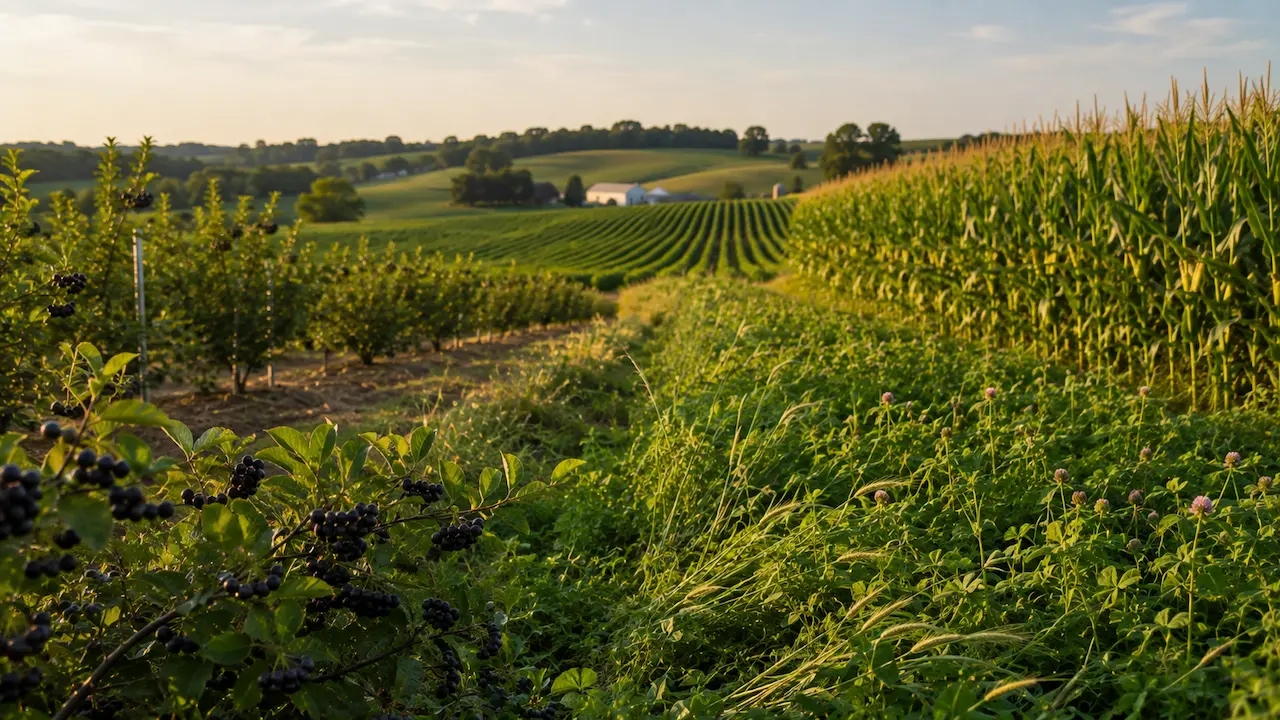
On my farm, balancing risk through diversification helps alleviate financial risk. I grow and market perennial fruits such as honeyberries (June harvest), tart cherries (July harvest), and aronia berries (August harvest). These seasonal opportunities offer local products to the community and their staggered production means there is always something healthy to offer the market. Moreover, the ultimate benefit is the opportunity to engage my children in the fun of the work, together.
Honoring the History and Legacy of Land (Place)
There is a need for continual assessment on farms. This can be accomplished through on-farm practical research for example. Through efforts to contribute to a larger body of knowledge, I share my research in the public domain.
I am investigating ways to no-till corn successfully by committing some acres to a joint research project with Iowa State University and University of Wisconsin-Madison. For his trial, I have seeded hairy vetch which will be roller crimped in the 2021 season.
Also, I contribute creatively to pass on an oral history of my farm. I aim to accomplish the need for land to have a legacy through the stories, songs, poems, and the like which I produce and publish. My book of farm poems can be found on Amazon Books. My Podcast can be found on Anchor, Spotify, Google Podcast and other platforms.